hile Wall Street was busy hitting all-time-high, the other Great Wall Street was quietly doing the same. For the better part of a decade, the conventional wisdom on Chinese equities among Western asset managers could be summarised in a single word: AVOID. Regulatory crackdowns, geopolitical friction, property sector stress and the spectre of delisting risk made China a market that most global funds quietly moved to underweight - and kept there. The consensus is now unwinding at speed and we are seeing the biggest capital rotation of 2026. The implications for global markets and digital assets are significant and worth looking at carefully.
Dragons, Discounts and DeepSeek: The $29 Billion Capital Flood Into Chinese Equities
Aleisha Lee • May 23, 2026

Aleisha Lee, CPA, Licensed RE Agent (Queensland)
23 May 2026 < 6 minutes read

The Global Capital Story
The capital flows that are beginning to reshape global asset allocation deserve the attention of every serious market participant, including those whose portfolios are weighted toward digital assets. This is not a story about a single data point or a short-term tactical trade. It is a story about a structural shift in where global capital is flowing, and what that means for everything from Bitcoin to bond yields, from Sydney property to sovereign wealth fund allocations, from emerging market currencies to the future of AI infrastructure finance.
Capital, by its nature, is indifferent to narrative. It moves toward return, away from risk and in response to relative value. When the world's second largest equity market begins to reprice after years of being systematically underweighted by global institutions, the reverberations are felt across every asset class simultaneously.
For investors accustomed to a world where US equities dominated every conversation about capital allocation, the events of the past six months represent something genuinely unusual. A compelling, well-capitalised alternative has emerged. It is one backed not by hype or manipulation,
but by valuation, AI-driven earnings and a coordinated institutional upgrade cycle that is still in its early stages.
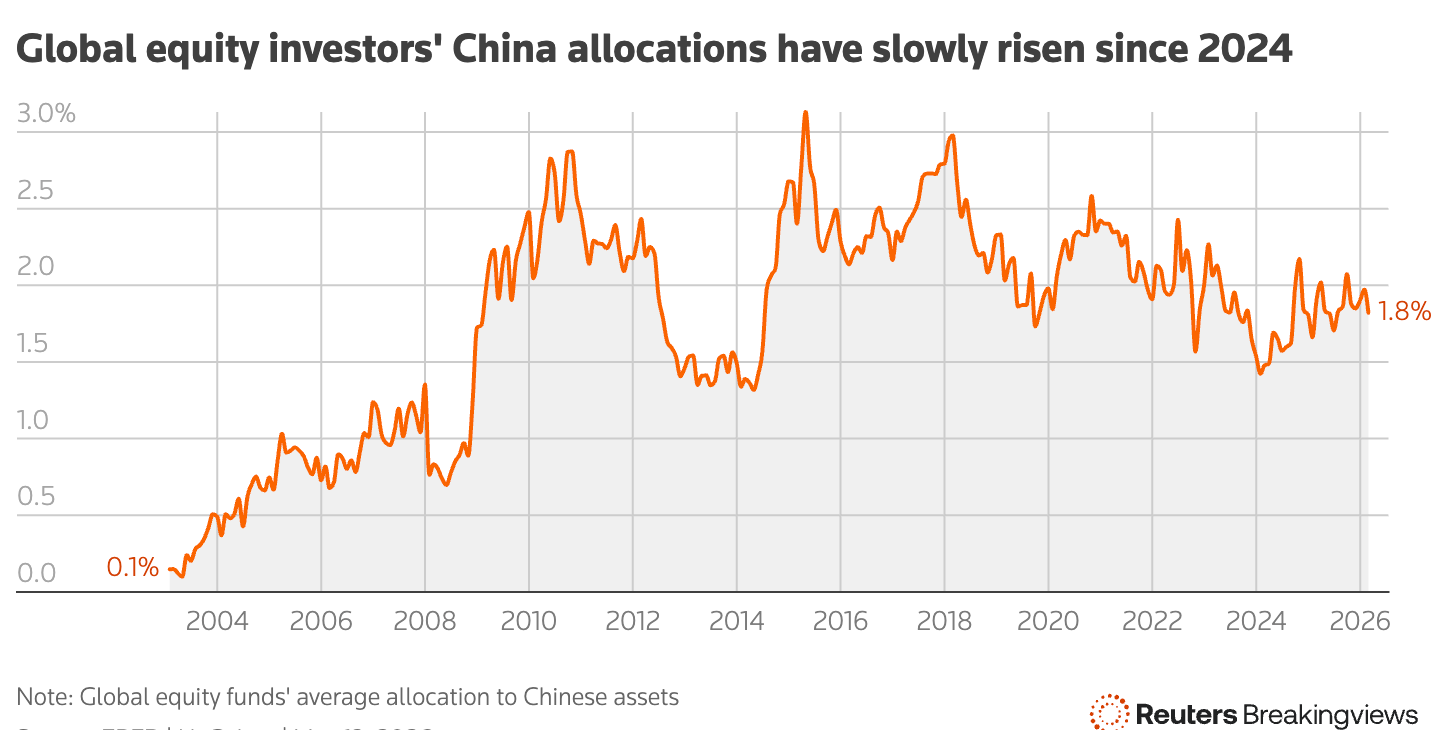
Source: Reuters Breaking News
The Numbers
Net inflows
into Chinese mainland equities hit ¥200 billion yuan, approximately USD $29 billion, in April 2026 alone, the strongest single month of foreign buying since January. This figure does not exist in isolation. Between January and October 2025:
- Foreign investors
poured USD $50.6 billion into Chinese and Hong Kong equities, up from just USD $11.4 billion over the same period a year earlier. This represents a fourfold increase in twelve months, according to the International Institute of Finance.
- Southbound flows from mainland investors into Hong Kong hit a record HKD $1.1 trillion in 2025, with projections of a further HKD $1.5 trillion in 2026 across mutual funds, passive ETFs, insurance companies and private funds.
- Daily trading turnover across the Shanghai, Shenzhen and Beijing stock exchanges climbed to successive record highs, peaking at ¥3.99 trillion yuan, surpassing the previous record of ¥3.48 trillion yuan set in October 2024.
These are not the numbers of a market drifting cautiously higher. They are the numbers of a market experiencing a structural repricing.

Source: Getty Image
Six Catalysts Driving the Inflow
1. The Valuation Gap is Historically Wide
The most immediate and compelling reason for foreign capital rotation into China is simple arithmetic. According to CoinDesk, the Hang Seng China Enterprises Index currently trades at 10.7 times forward earnings, versus the S&P 500 at 22.3 times and the MSCI Asia Pacific Index at 15.3 times.
The MSCI China Index trades at a forward PE ratio of just 11 times, far below India's 21 times and the Nasdaq 100's elevated multiple. China's weight in the MSCI ACWI stands at just 3.3%, which is significantly below its approximately 20% share of global economic output.
That underweight positioning relative to economic weight
represents a structural imbalance that global fund managers are increasingly finding difficult to justify to their investment committees.
History tells us that when that imbalance corrects, it rarely does so gradually.
Source: Reuters
2. DeepSeek Changed the Narrative Permanently
The second catalyst is one that reframed the entire conversation: the emergence of DeepSeek - one that most Western media initially dismissed as hype.
JPMorgan reports China's generative AI user base has climbed to
600 million, up 142% from 2025.
DeepSeek's latest
V4 model, optimised specifically for domestic semiconductors, has accelerated AI integration across
ByteDance, Tencent and
Alibaba.
JPMorgan now expects Chinese technology stocks to outperform the broader market.
DeepSeek's
open-source model
trained
on a fraction of the compute power and cost of leading US models, demonstrating that China can
compete at the frontier of AI without dependence on US chips. The model is being optimised to run on
Huawei's Ascend chips, further reducing reliance on US technology stacks.
Coinme has recently reported that DeepSeek is currently in discussions that could value the company at USD $45 billion, up from an initial estimated valuation of USD $20 billion just weeks earlier, with China's state-backed Big Fund reportedly leading the round.
The strategic implication is significant. China has demonstrated it can develop competitive frontier AI models domestically. The label
"uninvestable"
that dominated Western analyst commentary as recently as 2023 has therefore been replaced, with notable speed, by
"undervalued."
Source: South China Morning Post
3. Institutional Upgrades Are Arriving Simultaneously
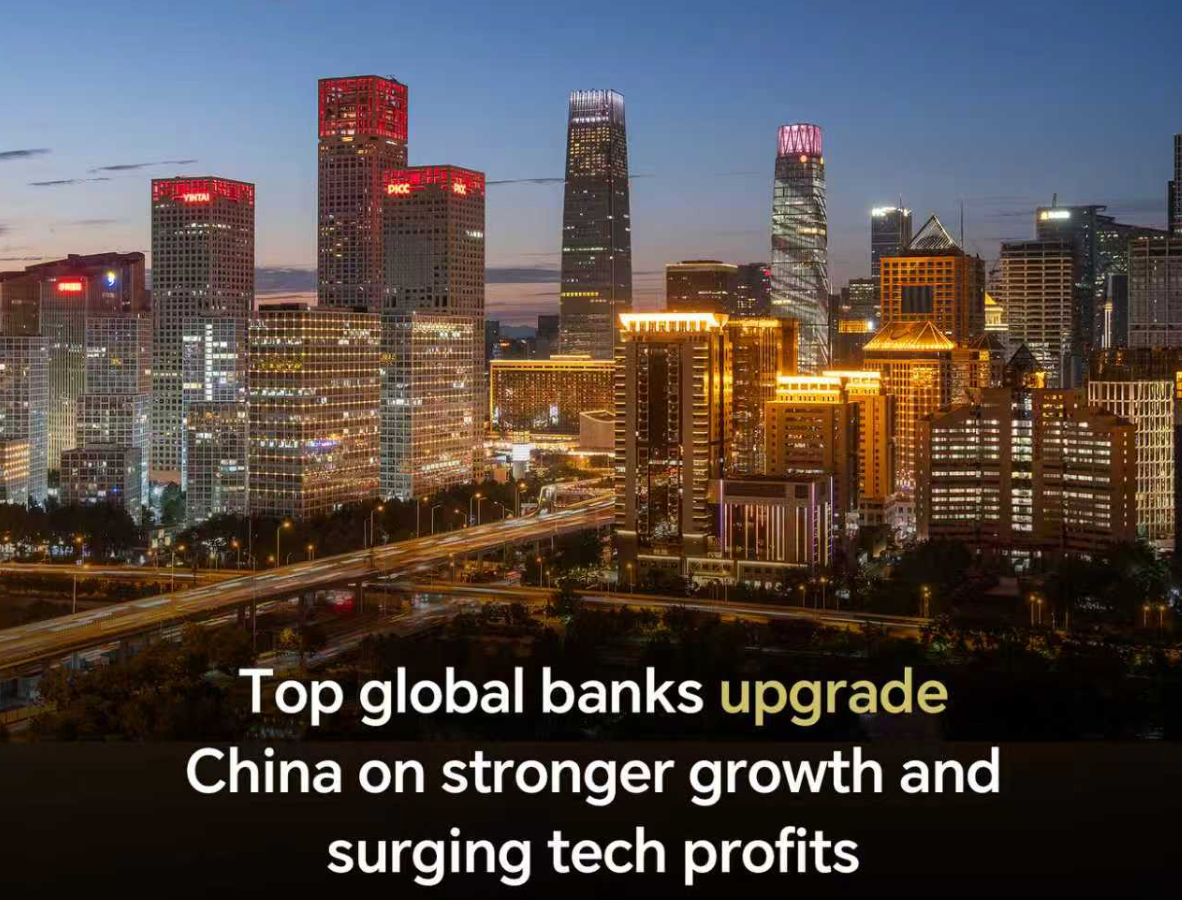
- UBS has maintained an "attractive" rating on Chinese stocks, forecasting 14% earnings growth for the MSCI China Index in 2026.
- Goldman Sachs raised its year-end target for the CSI 300, implying 9% upside, citing AI monetisation, policy stimulus and liquidity overshoot as the primary drivers.
- Goldman Sachs also estimates cumulative global spending on AI infrastructure could reach USD $7.6 trillion by 2031, with Chinese technology companies positioned to benefit from a broad-based expansion in global AI capital expenditure.
Global fund managers currently allocate just 1.2% of portfolios to Chinese AI-related stocks, far below China's estimated 10% share of global AI market capitalisation and 16% share of sector revenues. This allocation gap between current positioning and China's actual economic and technological weight, represents the structural opportunity that institutional capital is beginning to close.
Source: Nikkei Asia
4. Currency Tailwinds Add a Second Layer of Return to Foreign Investors
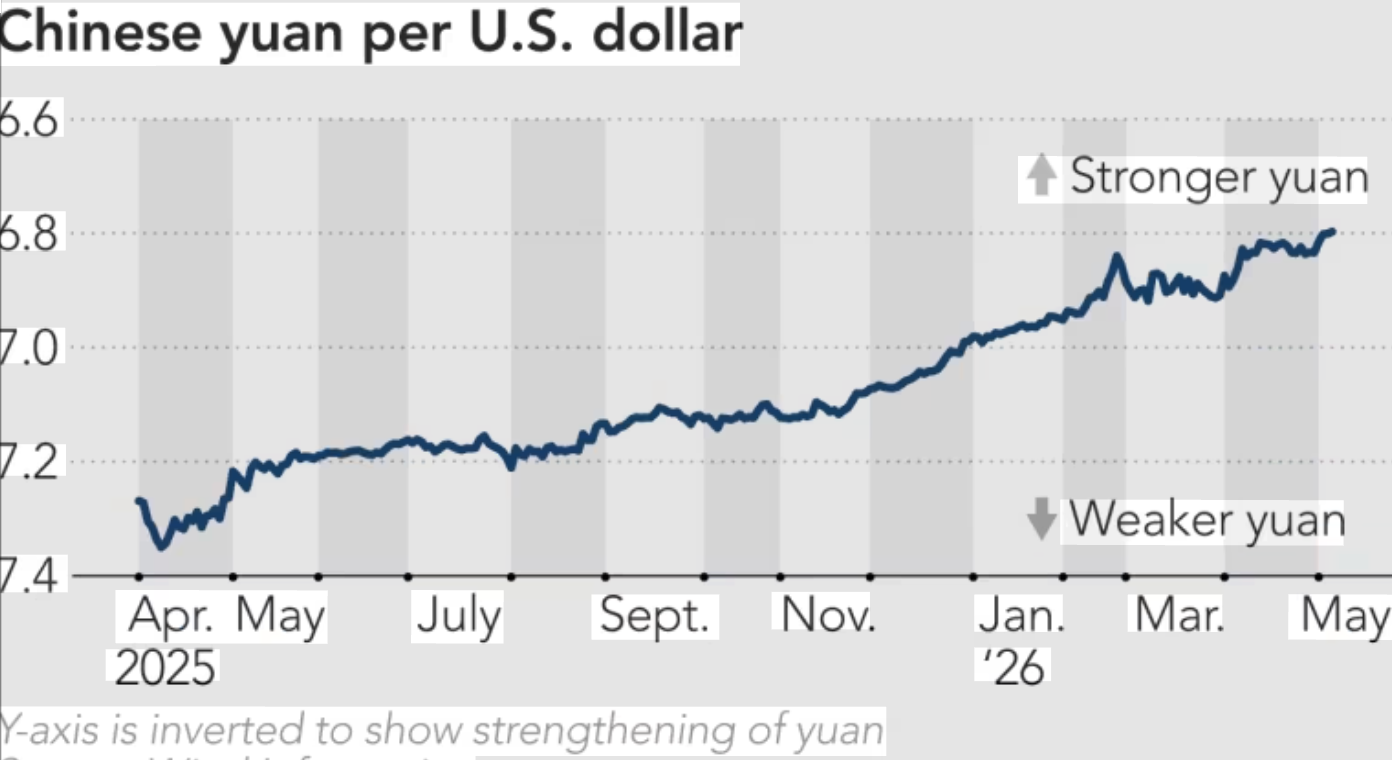
For foreign investors, equity returns in Chinese markets are denominated in yuan. A strengthening yuan therefore delivers currency appreciation on top of equity appreciation, a compounding tailwind that significantly enhances the total return proposition.
- Citigroup expects the yuan to undergo "managed appreciation," strengthening to 6.8 against the US dollar within 6–12 months.
- BNP Paribas Asset Management targets the 6.5–6.8 range.
- Eurizon SLJ Capital has set a year-end 2026 target of 6.25.
If those forecasts prove accurate, a foreign investor holding Chinese equities earns equity gains and a currency gain simultaneously. In an environment where US dollar strength has been a persistent headwind for emerging market returns, a sustained yuan appreciation cycle would represent a meaningful structural change in the risk-return calculus.
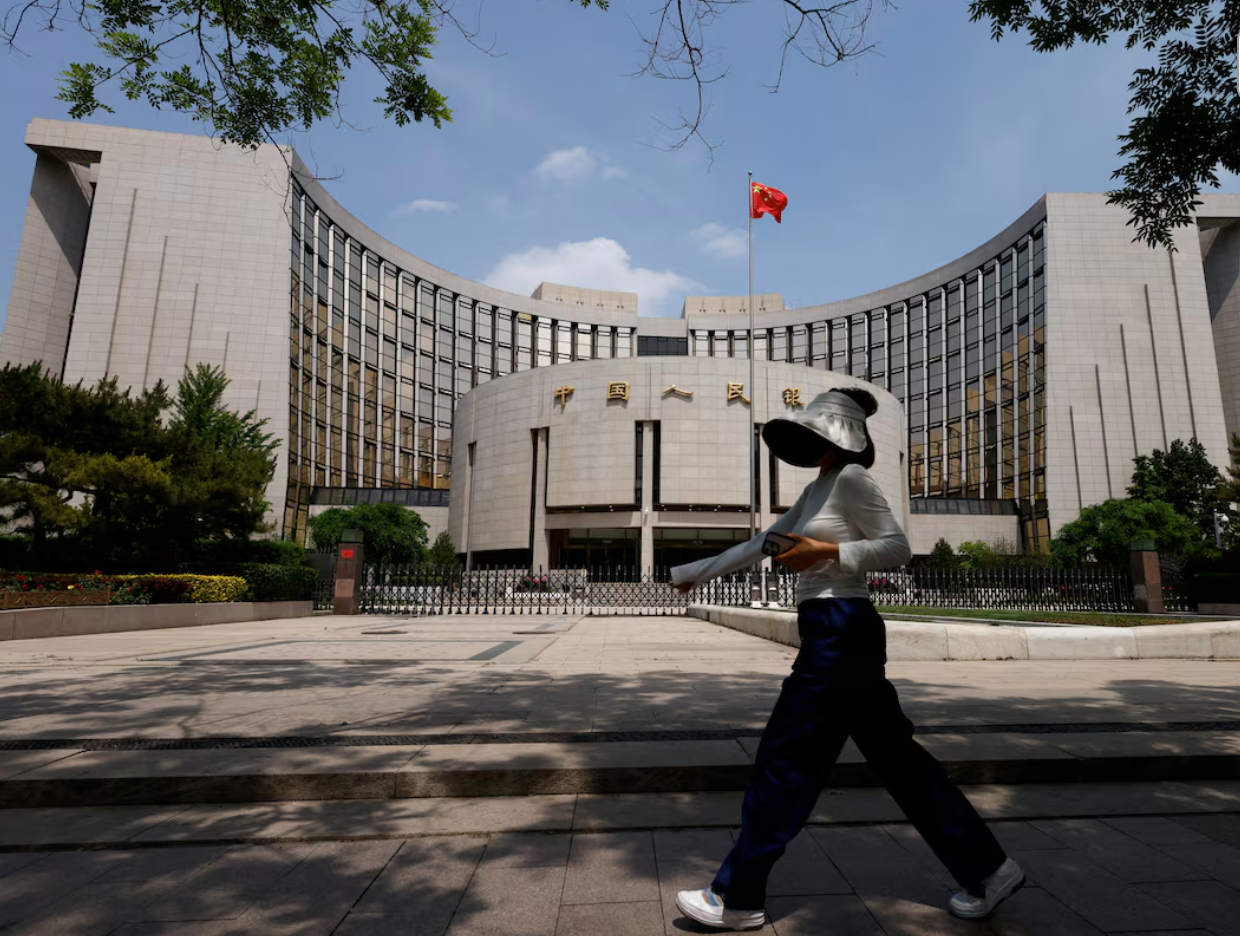
Source: Reuters
5. Policy Divergence Creates a Compelling Macro Backdrop
While the United States debates whether to hold or hike rates against a backdrop of 3.8% CPI and 6.0% PPI, and the newly sworn in Fed Chair — Kevin Warsh, inherits a Federal Reserve caught between challenging inflationary pressures and slowing growth, China has been actively easing.
- Beijing has cut reserve requirement ratios, injected liquidity, provided targeted stimulus to the property sector and maintained a broadly accommodative monetary stance.
- The late 2025 US-China trade truce lowered tariffs and paused further escalation until late 2026, easing pressure on exporters and contributing to the year-end surge. China's trade surplus for 2025 exceeded USD $1 trillion, bolstering domestic market sentiment.
A central bank that is easing into an economy that is stabilising, combined with a stock market trading at half the valuation of its Western peers, is a structurally attractive proposition for global capital seeking alternatives to an expensive and politically uncertain US equity market.

Source: CNBC
6. The AI Investment Super-Cycle is Accelerating
The scale of AI investments flowing into China is significant and the data tells the story.
- In the first quarter of 2026, investors deployed USD $300 billion across startups globally, with roughly USD $242 billion, or 80%, going directly to AI companies. This concentration marks a sharp acceleration from the prior peak of 55% in Q1 2025.
- Median AI deal sizes in China have risen from USD $4 million in 2020 to USD $7.4 million in 2026. In semiconductors specifically, median round sizes hit USD $27.45 million in 2025 and have surged further to USD $30.48 million in 2026.
- Foreign direct investment in high-tech services (including research and design) has surged 127.8% YoY in Q1 2026, as global companies expanded local innovation capabilities inside China.
This is not speculative capital chasing momentum. It is strategic capital betting on China's position in the defining technology competition of the decade.
What This Means for Digital Assets
The connection between Chinese equity flows and cryptocurrency markets is less obvious than it might appear, but it is real and worth understanding on two distinct time horizons.
- Short-term: A competing destination for capital.
The rotation of institutional capital into Chinese equities is part of a broader global reallocation away from expensive US assets. That same capital pool is what drives institutional demand for Bitcoin ETFs. When a compelling alternative emerges, ie. Chinese tech at 10.7 times earnings versus the S&P 500 at 22.3 times, some portion of the capital that might otherwise have entered digital assets will flow to equities instead. This is a short-term headwind for Bitcoin demand at the institutional level.
- Long-term: The historical Chinese capital cycle.
Periods of sustained yuan appreciation combined with Chinese domestic policy uncertainty have historically coincided with increased Chinese capital flows into Bitcoin as a portable, censorship-resistant store of value. The pattern was evident in 2017 and again in 2021. A strengthening yuan and a policy environment that encourages capital mobility, even if partially, would create the conditions for that dynamic to recur.
The capital rotation currently underway into Chinese equities is not a Bitcoin story today. But the downstream effects in currency flows, in energy demand from AI infrastructure buildout, and in the eventual reallocation of Chinese household wealth seeking diversification, make it a Bitcoin story in the making.

Key Takeaways
- DeepSeek was the catalyst, but valuation was the foundation.
The narrative change around Chinese AI is real and significant. It landed on a market that was already trading at a 50% discount to US peers. Narrative alone does not move capital at this scale, but valuation does.
- Bitcoin holders should watch Chinese capital flows.
Not because they are immediately correlated, but because the downstream effects on global liquidity, currency dynamics and energy demand are directly relevant to digital asset markets over a 12 to 24-month horizon.
- The risks are known and not fully priced.
Regulatory risk, the 2015 analogy, real economy divergence and geopolitical uncertainty are not obscure tail risks. They are well-understood factors that are keeping Western institutional positioning below its long-run equilibrium. That underweight is precisely what creates the opportunity.
- The most dangerous position in markets is the consensus one. For the better part of a decade, underweighting China was the consensus. The capital flows of the past six months suggest that consensus is in the early stages of reversal. Whether it accelerates, stalls or reverses again will be one of the most consequential questions in global asset allocation for the remainder of 2026.
This is what the generational re-entry looks like. The rotation has begun. The re-rating is real. As foreign capital floods back into Chinese equities at a pace not seen in years, driven by valuation discipline, AI-led earnings and a coordinated institutional upgrade cycle that is still in its early stages, the rest of the world is only beginning to reckon with what that means.
The dragon has finally woken up, and it knows exactly where it left its portfolio.
Thank you for being here. This research is free because readers like you make it possible. If it helped you see the markets a little more clearly, buying me a coffee is the loveliest way to say so. Every contribution goes directly toward more research and keeping BottleHodl independent and ad-free. Follow this link to donate any amount you like, every coffee counts. ☕ https://www.buymeacoffee.com/AleishaLee
Please remember, everything here reflects my personal perspective as a market commentator and analyst, not financial advice.
Always do your own research!
Stay Informed! Stay Sharp! See you in the markets. xx 💓
— Aleisha Lee
@BottleHodl |
aleishalee.com.au
Disclaimer
This article is for general informational purposes only. I give no warranty and accept no responsibility or liability for the accuracy or the completeness of the information and materials contained in this article and on this website. Under no circumstances will I be held responsible or liable in any way for any claims, damages, losses, expenses, costs or liabilities whatsoever (including, without limitation, any direct or indirect damages for loss of profits, business interruption or loss of information) resulting or arising directly or indirectly from your use of or inability to use this website or any websites linked to it, or from your reliance on the information and material in this article and on this website. NOTHING ON THIS WEBSITE IS FINANCIAL ADVICE.

While global markets fixate on the Strait of Hormuz and the Fed, one of the most consequential financial events of 2026 is quietly building in Tokyo. BOJ is actively transitioning away from decades of ultra-loose monetary policy and the ripple effects are already being felt across global financial markets.
As Hash Ribbon Indicator at a crossover and $BTC hovering in the deep value zone, is market aligning for a new phase of accumulation?
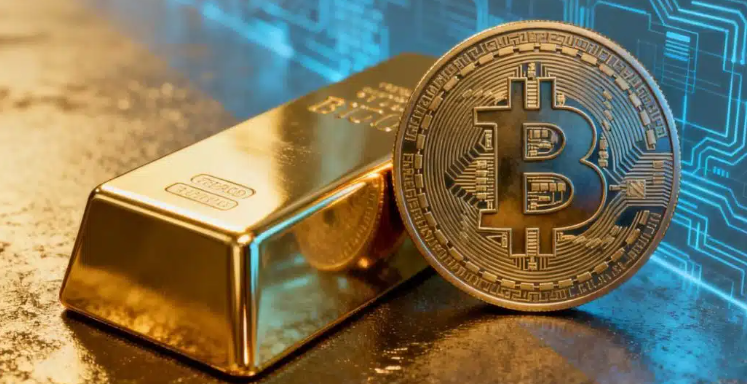
Recent price movements illustrate gold’s resilience and BTC’s failure as a hedge. While gold has rallied through macro and geopolitical headwinds — tariffs, the Iran conflict, government shutdowns, and currency crises, Bitcoin has largely moved in tandem with risk assets, failing to protect investors during turmoil.
The imminent approval of Solana Spot ETFs will mark a major disruption in traditional markets. Setting the next crypto frontier, Solana is not just another token, it's ultra-fast, super cost effective and developer-friendly blockchain that powers a vast and growing ecosystem of real-world applications. From DeFi and tokenised payments to NFT platforms and Web3 gaming, Solana offers unmatched scalability and speed that rival traditional financial systems can't beat. Now its inclusion in ETF offerings signals a shift in regulatory momentum and investor appetite. Read on....

Desires are strong and dream last long. Mass-market brands sell us reality, whilst luxury brands have the incredible ability to sell us dreams. Through compelling storytelling, these brands ignite our immediate desires to imitate an ideal world that’s exclusive, successful, glamorous and prestigious which ultimately translates into our willingness to pay a premium for their products. Read on to find out the rationale behind this price phenomenon in the world of luxury.

Known for bear hugs, affection, smiles, and wisdom, grandparents are special. They tell the best stories, have the answers to everything, not to mention the candy treats. How can we embrace the power of AI technology to make sure that our Nan and Pop age happily in their golden years?

In the last few months, it has been near impossible to exist on the internet without noticing NFTs, the technology dominating the world of collectibles, art and gaming. In this month's post, I will bring you to the crazy, wild and expensive world of NFTs where millions and millions of dollars worth of NFTs have changed hands, but nothing makes any sense. In the relatively short history of the crypto world, from the ICO boom in 2017, the smart contract platform era in 2018, Stablecoin in 2019, DeFi craze in 2020, in 2021, the torch has passed on to NFTs. Is NFTs another 'Tulip Mania' - an enormous bubble waiting to pop? Is it just another crypto wave that just comes and goes, or is it a paradigm shift that is incredible and inevitable?

Are diamonds just 'girl's best friend'? This post explores the world of men's jewellery, from the lavish splendour in the Renaissance era and heavy metal in the world of rock 'n' roll to modern day fashion statement, an expression of style that embraces androgyny and individuality. The moment you say ‘men’s jewellery’, it’s not unusual to think high-wattage gold chains and enormous rings encrusted with too much diamonds that rappers wear.

Explore how the coronavirus pandemic has shaken up and transformed the billion-dollar industry. Gone are the days when international university students and Chinese aunties with hessian shopping trollies sweeping baby formulas off the shelves while frantically WeChatting their buyers in China to finalise the transaction, choking up almost every Chemist Warehouse store, making parents furious over baby formula shortages. Desperate mums like myself had to scour pharmacies, supermarkets, Kmart, Big W, eBay, Amazon, you name it, for a tin of organic infant formula for my baby boy. It was an ongoing struggle until the coronavirus pandemic hit our shores and government closing the border to all international travellers. Overnight, it upended inbound tourism and disrupted the entire Daigou ecosystem and the logistics network.