hile headlines chase the Strait of Hormuz and Fed speculation, the most consequential financial story of 2026 is unfolding in near silence — in Tokyo. Understanding why starts with one simple question: where has the world's cheap money actually been coming from? Allow me to explain...
Why Japan Is About To Reshape Global Liquidity — And What It Means For Stocks, Bonds And Crypto
Aleisha Lee • April 25, 2026

Aleisha Lee, CPA, Licensed RE Agent (Queensland)
25 April 2026 < 7 minutes read

The Bank of Japan (BOJ) is actively transitioning away from decades of ultra-loose monetary policy, and the ripple effects are already being felt across global financial markets. As of December 2025, the BOJ raised its key short-term policy rate to 0.75%, the highest level since 1995, marking a decisive break from the near-zero rate environment that defined Japanese monetary policy for a generation.
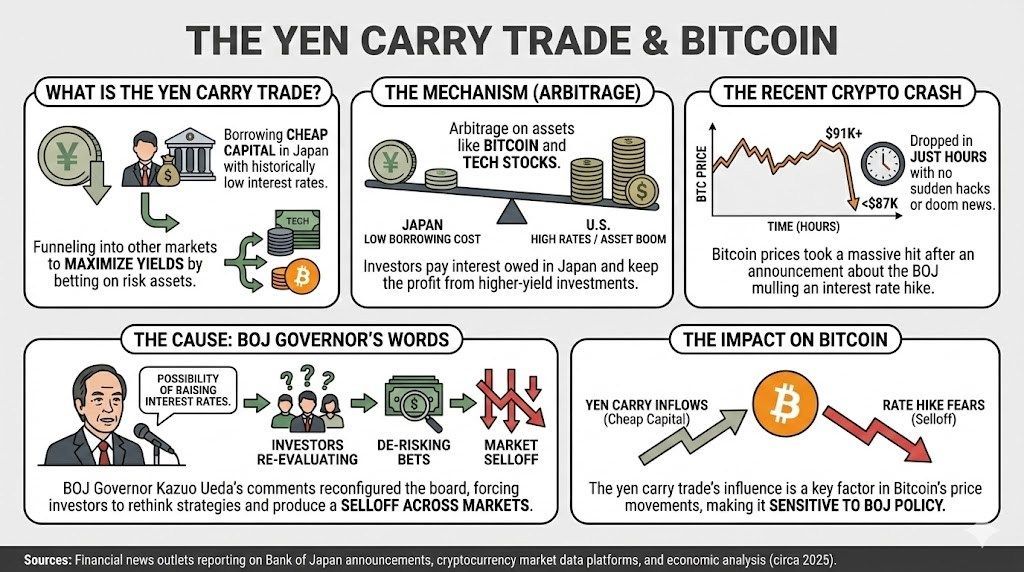
This policy shift matters far beyond Japan's borders. For over three decades, Japan served as the world's primary source of "cheap money" through what markets call the Yen Carry Trade — a mechanism where traders and institutions borrow yen at near-zero cost and rotate that capital into higher-yielding assets globally, from US tech stocks and government bonds to emerging markets and crypto. As the BOJ raises rates, the cost of borrowing yen rises, the yen strengthens, and those trades begin to unwind — creating a significant liquidity headwind for risk assets worldwide as capital is pulled back to repay yen-denominated loans.
Next week's BOJ meeting on April 27-28 was widely expected to deliver the next rate hike to 1%. However the BOJ has now solidified plans to hold steady at 0.75%, delaying the move to June 2026 as Middle East tensions drive crude oil prices higher — simultaneously fuelling forced-spending inflation while threatening economic growth, a difficult combination for any central bank to navigate.
The 1% hike is not a question of if — only when. And when it arrives, Japan will be operating at its highest interest rate in nearly three decades, dismantling the cheap liquidity conditions that global markets have quietly relied on for years.
The carry trade unwind that follows won't just be a Japan story. It will be felt in global stocks, bonds, property and crypto simultaneously.
Source: Bitcoin.com News
Japan - the world's ATM
Think of it like this: Japan has been the world's ATM for three decades. Traders and institutions borrow yen cheaply, convert it to dollars, and pour it into US stocks, bonds, real estate, crypto — anything with a better return than near-zero Japanese rates. It's been the single largest source of cheap global liquidity for a generation.
According to data published by Fortune Magazine, Japan holds approximately $1.2 trillion worth of US Treasuries alone. Japanese banks and institutions also invest heavily in global bonds, stocks, and other risk assets, making Japan a key source of global liquidity.
When Japan raises rates — that ATM starts charging fees. And the whole world pays!

Source: Bloomberg
What Happens When The Yen Carry Trade Unwinds
When Japanese rates rise, the maths of the carry trade breaks down fast and the following two events happen simultaneously.
- Borrowing yen becomes more expensive, meaning higher repayments.
- The yen strengthens, meaning currency losses.
The result is often a forced, cascading unwinding of trillions in positions across every asset class on earth. Yen rate hikes mean the global liquidity tap is closing, pressuring global asset prices dependent on cheap funding. We've already seen this move played out in preview.
Bitcoin fell nearly 3% shortly after the Bank of Japan raised rates to 0.75% in January 2026 — showing how quickly markets react when global liquidity conditions change. That was just a 0.25% hike. The next move takes Japan to a rate level not seen since the 1990s.
This is exactly why carry trade unwinding can trigger severe global market volatility.
Source: Reuters
Impact on Global Stock Markets
US technology stocks have been among the primary beneficiaries of cheap yen-funded liquidity for years — and when carry trades unwind, institutions are forced to sell their highest-performing, most liquid positions first, meaning US tech leads any selloff.
In August 2024, a surprise BOJ rate hike triggered one of the sharpest single-week market moves in recent memory — the Nikkei dropped over 12%, the S&P 500 fell sharply, and volatility spiked globally as carry trade positions unwound faster than markets could absorb.
As Japanese rates rise toward 1%, the incentive for Japanese institutional players — life insurers, pension funds and banks — to bring capital home increases significantly, fundamentally restructuring global capital flows.

Source: CoinPedia
Impact on Bond Markets
Japan already carries the world's highest debt-to-GDP ratio at almost 230%, and with Japanese Government Bond yields hitting multi-decade highs, the fiscal strain of rising rates is building rapidly. As domestic yields become more attractive, Japanese institutional players — the world's largest holders of foreign bonds — have increasing incentive to sell US Treasuries and repatriate capital, putting upward pressure on US Treasury yields and tightening credit conditions globally.
The flow-on effect touches everyone. Rising US Treasury yields push up mortgage rates, corporate borrowing costs and government debt servicing expenses worldwide. In plain English — when Japan raises rates, it becomes more expensive for governments, businesses and everyday consumers everywhere to borrow money.

Source: Bitcoin.com
Impact on Crypto
Bank of America warns that tighter policy in Japan may reduce global liquidity and trigger another sharp Bitcoin sell-off. If BOJ raises rates toward 1%, analysts warn Bitcoin could face a possible 4% to 5% decline, which may push Bitcoin closer to the next level of support at around $60,000.
The mechanism is straightforward:
- BOJ hikes to 1% → yen strengthens
- Carry traders unwind → sell foreign assets to repay yen loans
- Global liquidity contracts → risk appetite collapses
- Bitcoin and Altcoins, which trade as risk assets not safe havens, get sold alongside tech stocks
- Ethereum, Solana and smaller Altcoins → which carry more risk → amplified face-melting losses
Historical data shows yen rate hikes has a negative correlation with Bitcoin and broader crypto assets. Liquidity tightening suppresses risk asset prices broadly. This reinforces one of my earlier blog posts that Bitcoin is not digital gold. When macro fear spikes, BTC sells off with equities. The BOJ hike is precisely the kind of macro event that exposes that vulnerability.

Source: ByBit
The Silver Lining - it may be a "slow leak, not a dam breaking"
It is worth to note that even at 1%, Japan's rates remain dramatically lower than the US, Europe and Australia. The yield gap doesn't disappear overnight, it just narrows.
As I noted at the time of writing, with Japan at 0.75% versus the US at 3.75%, the differential may still be wide enough to keep carry trades attractive and discourage mass unwinding. Some analysts argue most yen carry trades have already been closed out following the 2024 unwind scare, suggesting the market has partially priced in the BOJ's interest rate direction. Under this view, any liquidity shock would likely prompt the Fed to ease, allowing markets to recover relatively quickly after an initial decline.
Key Takeaways
Japan's rate hike is delayed, not dead, and the window between now and then is narrower than markets think. When it lands, stocks, bonds and crypto will all feel the squeeze simultaneously as trillions in yen-funded positions are forced to unwind. US tech gets hit first, Treasury yields climb, Bitcoin - which has never been the safe haven it claims to be.
The yield gap between Japan and the US may soften the blow and prevent a full blown crisis, but make no mistake, the direction of Japan's monetary policy is clear. The BOJ April 27-28 meeting would be the first real signal. Watch the language around June guidance closely, because the carry trade doesn't send us a calendar invite before it unwinds. Stay calculated. Stay sharp!! 👀
Disclaimer
This article is for general informational purposes only. I give no warranty and accept no responsibility or liability for the accuracy or the completeness of the information and materials contained in this article and on this website. Under no circumstances will I be held responsible or liable in any way for any claims, damages, losses, expenses, costs or liabilities whatsoever (including, without limitation, any direct or indirect damages for loss of profits, business interruption or loss of information) resulting or arising directly or indirectly from your use of or inability to use this website or any websites linked to it, or from your reliance on the information and material in this article and on this website. NOTHING ON THIS WEBSITE IS FINANCIAL ADVICE.

As Hash Ribbon Indicator at a crossover and $BTC hovering in the deep value zone, is market aligning for a new phase of accumulation?

Recent price movements illustrate gold’s resilience and BTC’s failure as a hedge. While gold has rallied through macro and geopolitical headwinds — tariffs, the Iran conflict, government shutdowns, and currency crises, Bitcoin has largely moved in tandem with risk assets, failing to protect investors during turmoil.

The imminent approval of Solana Spot ETFs will mark a major disruption in traditional markets. Setting the next crypto frontier, Solana is not just another token, it's ultra-fast, super cost effective and developer-friendly blockchain that powers a vast and growing ecosystem of real-world applications. From DeFi and tokenised payments to NFT platforms and Web3 gaming, Solana offers unmatched scalability and speed that rival traditional financial systems can't beat. Now its inclusion in ETF offerings signals a shift in regulatory momentum and investor appetite. Read on....

Desires are strong and dream last long. Mass-market brands sell us reality, whilst luxury brands have the incredible ability to sell us dreams. Through compelling storytelling, these brands ignite our immediate desires to imitate an ideal world that’s exclusive, successful, glamorous and prestigious which ultimately translates into our willingness to pay a premium for their products. Read on to find out the rationale behind this price phenomenon in the world of luxury.

Known for bear hugs, affection, smiles, and wisdom, grandparents are special. They tell the best stories, have the answers to everything, not to mention the candy treats. How can we embrace the power of AI technology to make sure that our Nan and Pop age happily in their golden years?

In the last few months, it has been near impossible to exist on the internet without noticing NFTs, the technology dominating the world of collectibles, art and gaming. In this month's post, I will bring you to the crazy, wild and expensive world of NFTs where millions and millions of dollars worth of NFTs have changed hands, but nothing makes any sense. In the relatively short history of the crypto world, from the ICO boom in 2017, the smart contract platform era in 2018, Stablecoin in 2019, DeFi craze in 2020, in 2021, the torch has passed on to NFTs. Is NFTs another 'Tulip Mania' - an enormous bubble waiting to pop? Is it just another crypto wave that just comes and goes, or is it a paradigm shift that is incredible and inevitable?

Are diamonds just 'girl's best friend'? This post explores the world of men's jewellery, from the lavish splendour in the Renaissance era and heavy metal in the world of rock 'n' roll to modern day fashion statement, an expression of style that embraces androgyny and individuality. The moment you say ‘men’s jewellery’, it’s not unusual to think high-wattage gold chains and enormous rings encrusted with too much diamonds that rappers wear.

Explore how the coronavirus pandemic has shaken up and transformed the billion-dollar industry. Gone are the days when international university students and Chinese aunties with hessian shopping trollies sweeping baby formulas off the shelves while frantically WeChatting their buyers in China to finalise the transaction, choking up almost every Chemist Warehouse store, making parents furious over baby formula shortages. Desperate mums like myself had to scour pharmacies, supermarkets, Kmart, Big W, eBay, Amazon, you name it, for a tin of organic infant formula for my baby boy. It was an ongoing struggle until the coronavirus pandemic hit our shores and government closing the border to all international travellers. Overnight, it upended inbound tourism and disrupted the entire Daigou ecosystem and the logistics network.